Dee Agarwal's Advice on Choosing the Right Partners for Long-Term Growth
ATLANTA, GA, Jul 04, 2026, ZEX PR WIRE — When a company decides to partner with another company, the stakes are high, and the variables are many. Vendor relationships, strategic alliances, co-marketing agreements, joint ventures. The form changes, but the core challenge remains the same: how do you know, before the contracts are signed, whether this is a relationship built to last? For entrepreneur and executive Dee Agarwal, the answer lies beyond due diligence checklists and within the questions most companies forget to ask.
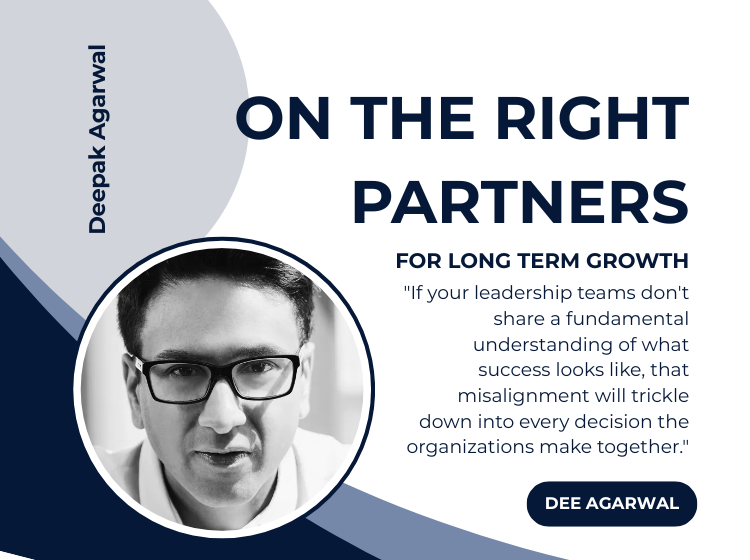
"Businesses spend enormous energy evaluating whether a potential partner can do the work," says Dee Agarwal. "They review capabilities, financials, and client lists. All of that matters. But the deeper question, whether the two organizations are actually built to work together over time, often doesn't get enough attention until something goes wrong."
Alignment Before Capability
Dee Agarwal's first principle when evaluating a company-to-company partnership is deceptively simple: lead with values, and then move into deliverables. Before assessing what a partner company can produce, he recommends taking a hard look at how they operate. Look at how they communicate under pressure, how they handle disputes, and how their leadership treats the people inside their own organization.
"You can usually tell a lot about a company by watching how they show up when things get complicated," he says. "In the early stages of a partnership conversation, introduce a little friction. Ask a hard question. See how they respond. That tells you more about long-term compatibility than any capability deck."
Dee Agarwal also stresses the importance of leadership alignment at the organizational level. When two companies partner, it's ultimately the people at the top who set the tone for how the relationship functions day to day.
"If your leadership teams don't share a fundamental understanding of what success looks like, that misalignment will trickle down into every decision the organizations make together," Dee Agarwal explains. "You'll be pulling in different directions without even realizing it."
Complementary, Not Competitive
For Dee Agarwal, the most productive company partnerships bring something genuinely different to the table on each side. A partner that duplicates your existing strengths adds redundancy. A partner that fills a real gap creates leverage.
"The question to ask is: does this partner make us capable of something we couldn't do alone?" he says. "Not just faster or cheaper, but with them, are we actually capable of things that weren't possible before? That's where real, durable value gets created."
At the same time, he warns against mistaking difference for alignment. Two companies can have entirely complementary capabilities and still be fundamentally incompatible if their growth ambitions point in different directions.
"Complementary strengths are a starting point, not a finish line," he says. "You also need to ask where both companies are trying to be in five years. If the answer takes you down different roads, the partnership has a ceiling, and you should know that going in."
Evaluate the Relationship, Not Just the Deal
One of the more counterintuitive pieces of advice Dee Agarwal offers is to be cautious of partnerships that feel too easy too quickly. When two organizations arrive at an agreement on everything with minimal friction, it can be a sign that one party is telling the other what it wants to hear rather than engaging honestly.
"A partner who challenges your thinking in the early conversations can be worth more than one who validates everything," he says. "The goal isn't to find a company that agrees with you all the time. It's to find one that makes you sharper. Some of the most productive partnerships involve real tension, because both sides actually care about the outcome."
He also emphasizes that companies should evaluate the relationship they're building, not just the transaction in front of them. This means asking: if the original terms of this deal change — if the market shifts, if priorities evolve — do we still want to be in this relationship?
Structure for Longevity
Dee Agarwal's final piece of advice is the one that distinguishes companies that partner well over the long term from those that treat every alliance as a short-term arrangement: build the partnership as if it will outlast the original opportunity.
"The deals that actually deliver long-term growth are the ones where both companies invested in the relationship, not just the contract," he says. "That means clear communication structures, shared metrics, and a genuine commitment to making the other side successful.”
"When you find a company that operates with that kind of mindset, hold onto that relationship. Partners like that are rare, and they're the ones that move the needle."
2026/07/04 13:08
Related Company PR
- Cambridge Global
- Cambridge Global
-
Dee Agarwal on the Impact of the Pandemic on Mobile eCommerce
- Cambridge Global
-
Dee Agarwal on Maintaining Work-Life Balance as an Entrepreneur
- Cambridge Global
-
Dee Agarwal on Setting the Right Growth Ambitions for your Business
- Cambridge Global
-
Dee Agarwal on How 'Buy Now, Pay Later' is Advancing Online Shopping
- Cambridge Global
- Cambridge Global
-
Dee Agarwal on 5 Important Steps to Sustainable Business Growth
- Cambridge Global
-
Dee Agarwal on The Importance of Encouraging Employees to Take PTO
- Cambridge Global
-
Live Music at Sea: How Margaritaville at Sea is Amping Up the Tunes
- Cambridge Global
- Cambridge Global
- Cambridge Global
- Cambridge Global
- Cambridge Global
-
Deepak Agarwal on the Rise of “Quiet Quitting” and How to Combat it
- Cambridge Global
-
Dee Agarwal shares 4 Tips for Boosting Productivity as a Leader
- Cambridge Global
-
Dee Agarwal on How Brands Can Prepare for The Great Wealth Transfer
- Cambridge Global
-
Dee Agarwal on 3 Ways to Effectively Lead a Diverse Workforce
- Cambridge Global
- Cambridge Global
-
Dee Agarwal on How to Optimize Your Professional Communications
- Cambridge Global
- Cambridge Global
-
Dee Agarwal on 5 Ways Employees Can Make an Impact at Any Level
- Cambridge Global
-
Deepak Agarwal on How to Nurture and Develop Effective Leaders
- Cambridge Global
-
Dee Agarwal on 3 Ways to Attract Better Talent to Any Business
- Cambridge Global
- Cambridge Global
- Cambridge Global
- Cambridge Global
-
Dee Agarwal's 7 Strategies for Managing Hybrid Teams Effectively
- Cambridge Global
- Cambridge Global
-
Jonathan Martin Explores The Likely Regulations Facing Bitcoin
- Cambridge Global
-
Navigating Rapid Scale Growth: Dee Agarwal's Blueprint for Success
- Cambridge Global
-
Dee Agarwal on the right KPIs to be thinking about for optimal ROI
- Cambridge Global
-
Navigating Larger Markets: Dee Agarwal's Checklist Before Scaling Up
- Cambridge Global
-
Dee Agarwal on Recognizing Industries That Are Ripe for Disruption
- Cambridge Global
-
Dee Agarwal on Reducing Decision Fatigue for Executives and Teams
- Cambridge Global
-
Diana Ulis of Admire Capital Appears on The Well Drop Podcast
- Cambridge Global